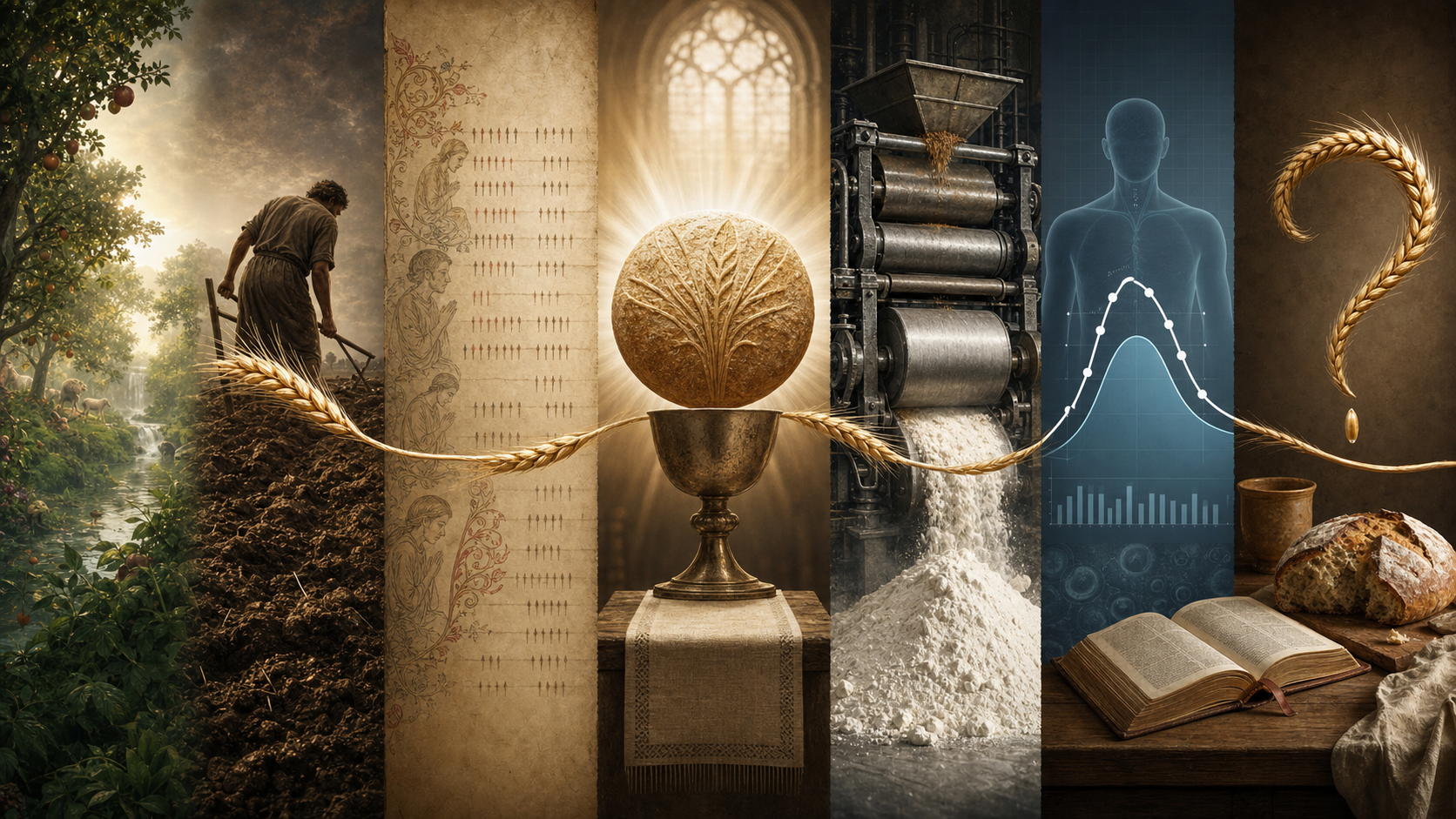
The book’s argument in one chain: curse, staff, daily bread, Eucharist, roller mill, metabolic reckoning.
Hold one image of bread as a chain of transformations laid over each other.
First comes the garden, where the human diet is given as seed-bearing plants and fruit. Then comes the curse, where bread appears not as Edenic gift but as the food of sweat, toil, and resistant ground. The first question is already there: if bread is the staff of life, why does scripture introduce it under the sign of exile?
Then the staff appears. In the Hebrew Bible, the “staff of bread” is the thing that supports life, and the thing God can break in famine and siege. Bread becomes the prop, the stay, the support. A civilization can lean on it.
Then the petition begins. “Give us this day our daily bread” becomes the most repeated Christian sentence about food in history. The prayer does not ask by name for meat, fruit, fish, oil, vegetables, or water. It asks for bread. The word translated “daily” is one of the strangest in the New Testament, and the choice of how to translate it pulled the prayer toward the ordinary loaf.
Then bread is lifted. In the Eucharist, bread is not merely requested but enacted as the body of Christ. The sacred loaf becomes the central physical object of Western worship. To question bread now is no longer just to question a staple. It is to approach an object carrying two thousand years of sacramental force.
Then the rollers turn. In the nineteenth century, industrial milling transforms wheat into refined white flour at a scale and purity earlier cultures did not know. The West inherits reverence for one kind of bread and mass-produces another.
Then the graph rises. Refined grain becomes glucose quickly. Glucose summons insulin. Repeated often enough, in the context of modern industrial food, the old staff becomes implicated in a new disease pattern: obesity, fatty liver, insulin resistance, type 2 diabetes, metabolic syndrome.
The final image is not condemnation. It is a question reopened. What if the West has been defending bread with reasons it no longer remembers? What if the metabolic argument cannot be heard until the sacred history of bread is heard first?
Continue: The Staff of Life in One Thousand Words